
Roadmap tegen agressie en unruly gedrag gepresenteerd
Leestijd: 2 minuten
Cabinepersoneel krijgt nog te vaak te maken met agressie, intimidatie of ander ordeverstorend gedrag aan boord. Dergelijk gedrag komt in de hele luchtvaartketen voor: op de luchthaven, bij de gate en tijdens de vlucht.
Om dit probleem structureel aan te pakken is een nieuwe roadmap tegen unruly passengers opgesteld. De VNC heeft actief bijgedragen aan de totstandkoming van dit plan. Op 5 maart is de roadmap officieel overhandigd aan de betrokken partijen uit de luchtvaartsector.
Voor de VNC is één ding duidelijk: veilig werken aan boord moet vanzelfsprekend zijn.
Cabinepersoneel staat in de frontlinie
Wanneer een situatie aan boord uit de hand loopt, moet cabinepersoneel als eerste handelen. Collega’s zorgen voor de veiligheid van passagiers, terwijl ze tegelijk proberen een conflict te de-escaleren.
Dat vraagt professionaliteit, maar ook duidelijke regels en ondersteuning vanuit de sector. Tijdens de overdracht van de roadmap benadrukte VNC-voorzitter Chris van Elswijk dat punt nog eens:
“Cabinepersoneel staat letterlijk in de frontlinie. Wij zijn verantwoordelijk voor de veiligheid aan boord en staan als eerste tegenover passagiers wanneer gedrag escaleert.”
Juist daarom vindt de VNC het belangrijk dat er concrete stappen worden gezet om agressie en ordeverstorend gedrag tegen te gaan.
Ontstaan uit het Platform Unruly Passengers
De roadmap is ontwikkeld binnen het Platform Unruly Passengers (PUP). In dit platform werken verschillende organisaties uit de luchtvaartketen aan oplossingen voor het toenemende aantal incidenten met passagiers. De VNC is hierbij aangesloten, net als o.a. luchtvaartmaatschappijen KLM, Transavia, Corendon en TUI, luchthaven Schiphol, het Ministerie van Infrastructuur en Waterstaat, de Koninklijke Marechaussee, het Openbaar Ministerie en andere partijen uit de sector.
Binnen dit platform is gekeken naar maatregelen die daadwerkelijk kunnen helpen om incidenten te voorkomen én beter aan te pakken wanneer ze toch gebeuren.
Wat staat er in de roadmap?
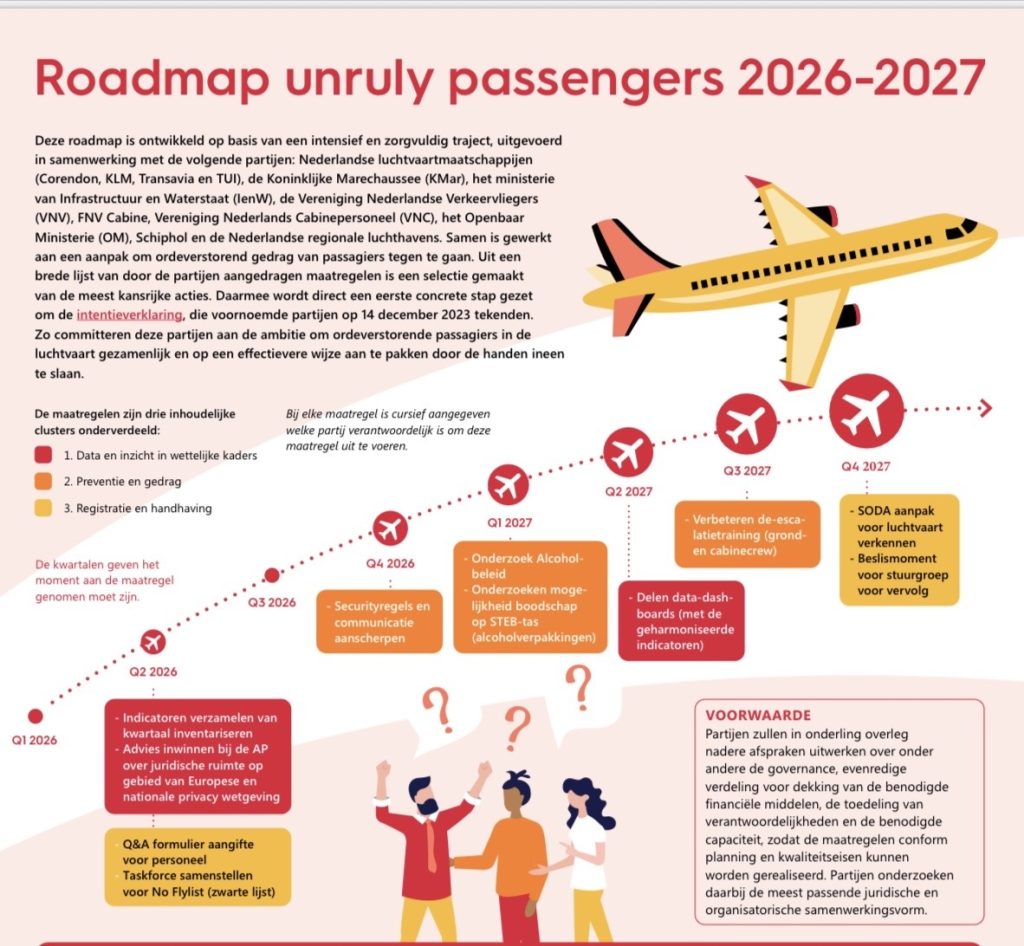
De roadmap bevat een reeks maatregelen voor de komende jaren. Het doel: minder incidenten aan boord en betere ondersteuning wanneer er toch iets gebeurt.
De belangrijkste aandachtspunten zijn:
- Meer inzicht in incidenten
Betere registratie en analyse van incidenten om patronen en risico’s eerder te herkennen. - Preventie en duidelijke communicatie
Passagiers beter informeren over regels en de gevolgen van ongewenst gedrag. - Extra aandacht voor training
Doorontwikkeling van de-escalatietraining voor grond- en cabinepersoneel. - Eenvoudiger aangifte doen
Het proces voor het melden en aangeven van incidenten moet duidelijker en toegankelijker worden voor personeel. - Onderzoek naar aanvullende maatregelen
Bijvoorbeeld rond alcoholgebruik of het delen van informatie over passagiers die ernstige overlast veroorzaken.
Zo ziet de roadmap eruit:
De rol van de VNC
De VNC was vanaf het begin betrokken bij het traject en legde de focus daarbij vooral op cabinepersoneel. Collega’s aan boord weten als geen ander wat er speelt tijdens vluchten: van kleine spanningen tot situaties die echt uit de hand lopen. Die praktijkervaring is belangrijk om maatregelen te ontwikkelen die in de praktijk ook echt werken.
We blijven ons inzetten om de ervaringen van cabinepersoneel onder de aandacht te brengen en om ervoor te zorgen dat maatregelen daadwerkelijk bijdragen aan een veiliger werkomgeving aan boord. Daarbij gaat het vooral om het melden van incidenten, goede ondersteuning en duidelijke grenzen stellen aan agressief gedrag van passagiers.
Vliegen moet veilig zijn en blijven: voor passagiers én voor alle collega’s aan boord en op de grond.
VNC bestuur
English Version:
Cabin crew are still too frequently confronted with aggression, intimidation or other disruptive behaviour on board. Such conduct occurs throughout the entire aviation chain: at the airport, at the gate and during the flight.
To address this issue in a structural way, a new roadmap targeting unruly passengers has been developed. The VNC has actively contributed to the creation of this plan. On 5 March, the roadmap was officially presented to the relevant parties within the aviation sector.
For the VNC, one thing is clear: working safely on board should be standard practice.
Cabin crew on the frontline
When a situation on board escalates, cabin crew must be the first to act. Colleagues ensure the safety of passengers while simultaneously attempting to de-escalate conflicts. This requires professionalism, as well as clear rules and support from across the sector. During the presentation of the roadmap, VNC Chair Chris van Elswijk emphasised this point once again:
“Cabin crew are literally on the frontline. We are responsible for safety on board and are the first to face passengers when behaviour escalates.”
For this very reason, the VNC considers it essential that concrete steps are taken to combat aggression and disruptive behaviour.
Developed through the Platform Unruly Passengers
The roadmap was developed within the Platform Unruly Passengers (PUP). Within this platform, various organisations across the aviation chain collaborate on solutions to the growing number of passenger-related incidents. The VNC is a participant, alongside airlines such as KLM, Transavia, Corendon and TUI, Schiphol Airport, the Ministry of Infrastructure and Water Management, the Royal Netherlands Marechaussee, the Public Prosecution Service and other sector partners.
Within this platform, measures were explored that can genuinely help to both prevent incidents and deal with them more effectively when they do occur.
What does the roadmap include?
The roadmap sets out a series of measures for the coming years. The aim: fewer incidents on board and better support when incidents do occur.
The key focus areas are:
- Greater insight into incidents
Improved recording and analysis of incidents to identify patterns and risks at an earlier stage. - Prevention and clear communication
Better informing passengers about rules and the consequences of unacceptable behaviour. - Increased focus on training
Further development of de-escalation training for ground and cabin crew. - Simplifying reporting procedures
Making the process for reporting and filing complaints about incidents clearer and more accessible for staff. - Exploration of additional measures
For example, relating to alcohol consumption or the sharing of information about passengers who cause serious disruption.
This is what the roadmap looks like: (Dutch only).
The role of the VNC
The VNC has been involved from the outset and has placed particular emphasis on cabin crew. Colleagues on board have first-hand experience of what happens during flights: from minor tensions to situations that genuinely spiral out of control. This practical experience is essential in developing measures that are effective in real-life situations.
We will continue to advocate for the experiences of cabin crew and to ensure that measures genuinely contribute to a safer working environment on board. Particular attention will be paid to incident reporting, proper support, and setting clear boundaries regarding aggressive passenger behaviour.
Flying must remain safe: for passengers and for all colleagues, both on board and on the ground.
VNC Board


